To write your own marriage vows: use a simple structure (opening, love story, promises, closing), keep them to 1–2 minutes (roughly 250–400 words), include one specific memory only the two of you share, make 3–5 concrete promises instead of vague sentiments, and read them aloud before the day. Below: a full step-by-step process, real wedding vow examples, traditional vs. personal vows compared, and answers to the questions couples search most. guide-to-writing-wedding-vows
Writing your own marriage vows is one of the most personal and most nerve-wracking parts of planning a wedding. If you’ve started your ceremony planning, you’ve probably typed some version of “how to write your own wedding vows” into Google already, hoping for a starting point that doesn’t sound like a template.
Great wedding vows aren’t about fancy language. They’re built from three things a real memory, a specific promise, and your own voice. This guide gives you a step-by-step process, full wedding vows examples for him and for her, a look at traditional wedding vows and wedding vows in the Bible, and answers to the questions couples ask most before their big day.
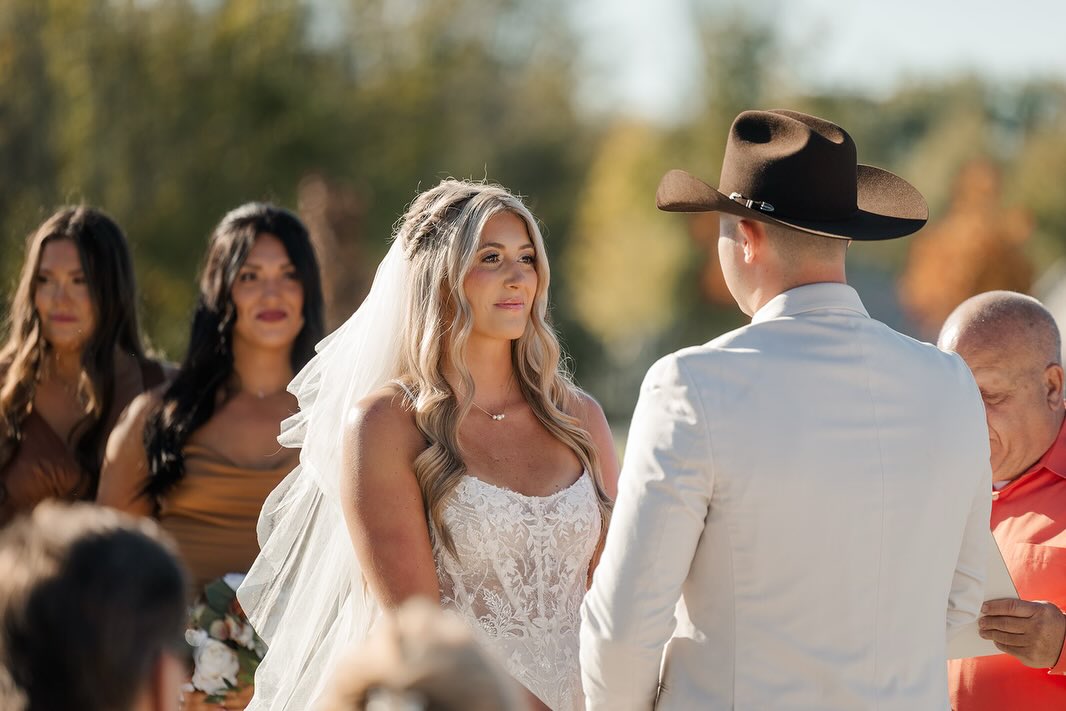
Since opening in 2022, The Grange Hall has hosted one wedding per weekend on our Richwood, Ohio farm several hundred vow exchanges on our patio, under our glass garage doors, and out on the North Patio by the pond. The pattern holds season after season: the vows guests still talk about a year later are rarely the longest ones. They’re the most honest ones.
What Are Marriage Vows?
Marriage vows are the formal promises a couple makes during the ceremony either traditional wedding vows recited from a religious or civil script, or personal wedding vows written by the couple. Self-written vows have become common enough that many officiants describe them as the norm rather than the exception; one longtime wedding officiant estimates roughly 70% of the couples they’ve married chose to write their own vows in some form a shift the Institute for Family Studies has also noted in modern American weddings. Figures vary by region and officiant, but the direction is clear and plenty of couples still blend both: a traditional opening line followed by something personal.
Traditional Wedding Vows vs. Personal Wedding Vows
A question we hear often on venue tours: “Do we have to write our own vows, or can we use traditional ones?”
| Traditional Wedding Vows | Personal (Self-Written) Vows | |
| Tone | Formal, time-tested, often religious | Personal and unique to your story |
| Effort required | Minimal provided by officiant | Higher requires planning |
| Best for | Religious ceremonies, nervous speakers | Couples wanting a distinctly personal ceremony |
| Length | Short, identical for both partners | 1–2 minutes each, fully customizable |
| Flexibility | Low set wording | High humor, faith, personal history |
Many couples choose a hybrid: a short traditional line (“I, [Name], take you, [Name], to be my lawfully wedded spouse…”) followed by their own promises.
Wedding Vows in the Bible
For faith-based ceremonies, most Christian marriage vows examples draw inspiration from:
- 1 Corinthians 13:4-7 the “love chapter,” on patience and kindness
- Ruth 1:16-17 “Where you go, I will go… your people shall be my people”
- Genesis 2:24 on two becoming “one flesh”
- Ecclesiastes 4:9-12 “a cord of three strands is not quickly broken”
Many couples weave a line into personal vows or have their officiant read one aloud beforehand. Check with your officiant early, since some denominations require specific traditional wording our own wedding FAQs page covers what’s allowed for ceremonies held at The Grange Hall, including outside officiants.
What to Include When Writing Your Own Wedding Vows
Strong personal vows almost always contain four building blocks: an opening/greeting (warm and genuine), a reflection (one specific memory, not your whole relationship timeline), concrete promises (commitments, not just feelings), and a closing statement (how you’ll carry this promise forward). Avoid trying to summarize the entire relationship, one well-chosen detail beats five generic ones.
How Long Should Wedding Vows Be?
Aim for 250–400 words, or 1 to 2 minutes spoken aloud. Vows over 3 minutes tend to lose the room and start feeling like a speech. Save extra sentiment for your reception toast.
Pro tip: print vows in large font, rehearse out loud at least five times, and time yourself nerves make people talk faster than rehearsed. If you’re still mapping out your ceremony timeline alongside your vows, our wedding day planning page walks through how the rest of the day typically flows.
How to Write Your Own Wedding Vows: Step-by-Step
- Talk to your partner first. Agree on a funny, romantic, spiritual tone so your vows don’t clash.
- Brainstorm before writing. List how you met, a moment you knew, inside jokes, promises you want to make.
- Choose a structure. Use the four-part outline above.
- Write promises as actions, not feelings. “I’ll always love you” is a feeling; “I promise to make you coffee on your worst mornings” is a commitment that is what makes heartfelt wedding vows actually feel heartfelt.
- Add one detail only you two know. The biggest difference between forgettable and unforgettable vows.
- Read it aloud, more than once. Vows are spoken, not read silently.
- Get one trusted second opinion, not the whole bridal party.
- Print or handwrite it for the day steadier than a phone screen if nerves hit.
Wedding Vow Ideas & Examples
Wedding Vows for Her (Example): “[Name], from the moment you laughed at my terrible joke on our first date, I knew I wanted to make you laugh for the rest of my life. I promise to be your safe place when the world feels loud, to celebrate every win like it’s the biggest news I’ve heard, and to choose you, again and again. You are my favorite person and my best decision.”
Wedding Vows for Him (Example): “[Name], you make even ordinary Tuesdays feel like an adventure, and I never want that to stop. I promise to support your dreams the way you’ve supported mine, to be honest even when it’s hard, and to build a life full of laughter and love. I choose you today, and I’ll keep choosing you every day we’re given.”
Unique & Romantic Vow Lines:
- “I promise to be your partner in crime, your calm in the chaos, and your biggest fan.”
- “With you, home isn’t a place. It’s you.”
- “I vow to keep choosing you, in every season, without hesitation.”
Short Traditional-Style Example: “I, [Name], take you, [Name], to be my lawfully wedded [spouse], to have and to hold from this day forward, for better or worse, in sickness and in health, to love and to cherish, until death do us part.”
Real Ceremonies, Real Lessons: Notes from The Grange Hall
We’re a family-owned, family-operated barn wedding venue on a working farm just north of Richwood, Ohio our story started with a farm purchased in 2018 and a 13,000-square-foot modern barn completed in 2022. Because we host only one wedding per weekend, our team is present, up close, for every ceremony. That vantage point is where these observations come from:
- Couples who practice out loud sound the most natural. First-time reads at the altar add visible nerves.
- Weather-proof your paper. Our outdoor spots, the North Patio by the pond and the area framed by our glass garage doors mean wind and humidity are real factors. Cardstock or a vow book holds up better than loose paper.
- Short and specific beats long and general, every time.
- Guests remember sincerity, not vocabulary. Browsing our real wedding stories, the vows couples still mention years later are almost always the simplest ones not the most elaborately written.
If you’re planning a wedding at a barn venue near Columbus, Ohio and want a quiet setting with full Friday-to-Sunday access, browse our wedding photo gallery, or schedule a tour of The Grange Hall.
Common Mistakes to Avoid
| Mistake | Fix |
| Writing vows the night before | Start 3–4 weeks ahead |
| Only vague promises (“I’ll always love you”) | Use specific, actionable commitments |
| Copying vows word-for-word online | Use examples as inspiration, then rewrite in your own words |
| Going over 3 minutes | Trim to 250–400 words, time yourself out loud |
| Mismatched tone with your partner | Discuss tone before either of you writes |
Frequently Asked Questions
Do we have to write our own wedding vows?
No. You can use fully traditional vows, personalize a template, or write completely original ones it’s your choice.
What should I include in my wedding vows?
A warm opening, one brief personal memory, 3–5 specific promises, and a heartfelt closing line.
How long should wedding vows be?
Most officiants recommend 250–400 words, or about 1–2 minutes spoken aloud.
Should couples show each other their vows before the wedding?
Personal choice, some like the surprise, others agree on the tone beforehand.
Can I read my vows off paper during the ceremony?
Yes, and most officials encourage it. Many couples keep the vow book as a keepsake.
What’s the difference between wedding vows and marriage vows?
The terms are used interchangeably. “Wedding vows” usually means the words spoken during the ceremony; “marriage vows” can also describe the broader lifelong commitment.
What are good opening lines for wedding vows?
Start with a name, a term of endearment, or a simple statement of feeling not a generic greeting.
Is it okay to add humor to wedding vows?
Yes, if it matches your partner’s comfort level. A line or two of humor mixed with sincerity lands best.
Final Thoughts
Writing your own marriage vows doesn’t require a background in poetry, just honesty, a little planning, and the willingness to say something true in front of the people you love. Start early, keep it specific, keep it short, and let your own voice do the work.
The setting matters too. At The Grange Hall, a modern barn wedding venue near Columbus in Richwood, Ohio couples exchange vows in a black modern barn with sweeping farmland views, with the privacy of one wedding per weekend and full Friday-to-Sunday access. Explore our packages and pricing or schedule your tour today.